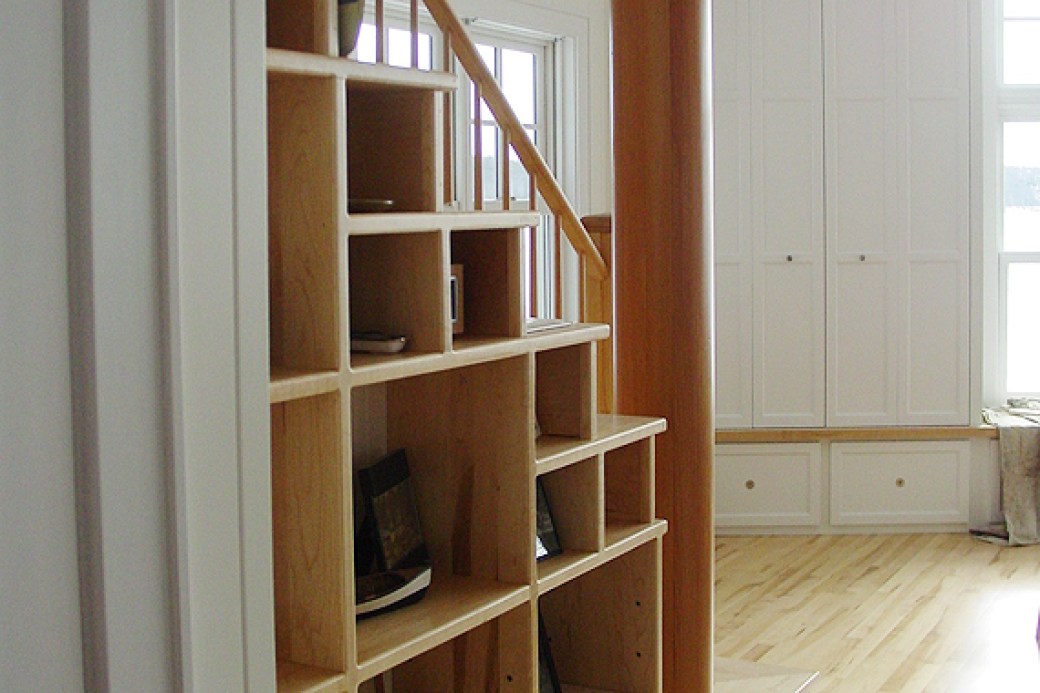

That hollow triangle of space beneath your staircase can house more than lint. Claim the square footage for organizing your stuff.
See which of these storage solutions trips your organizational trigger.
Closet
One of the simplest and most common under-stairs storage solutions, a closet can be lined with shelves and equipped with wire organizers to provide an abundance of organizational space. Include a light fixture in your plans.
Related: The Right Light Bulb for the Job
Cost: $250 to $500. Add $1,700 for professional installation; custom closet systems start at $1,000 and may climb to $30,000 for premium woods and all the bells and whistles.
Open Shelves
Rather than keep your belongings undercover, line the space beneath your staircase with built-in shelves that provide access from the side of the stairs. Use wicker baskets or canvas bins to corral smaller items.
Cost: If you do it yourself, $200 to $500. Expect to pay $1,000 to $3,000 for custom-made shelves built by a professional finish carpenter.
Related: Between-the-Studs Shelving and Storage: Find Your Niche in Life
Drawers
Drawer storage allows full view and access to your belongings in one smooth motion. Accessed from one side of a staircase, drawers can be designed in a variety of depths and widths. Or, build drawers into the risers of one or more steps.
Cost: $200 to $500 if you do it yourself; $2,000 to $5,000 if it's a custom-made built-in by a finish carpenter.
Cabinets
Built-in cabinets can feature solid doors or doors with glass inserts. Use clear glass when you want to keep books and treasures on display, or choose decorative opaque or translucent glass to obscure the contents.
Cost: $1,000 to $20,000.
Combination
You’re not limited to any single storage solution; instead, use a combination of shelves, cabinets, drawers, and other features to suit your needs. Options include wine cubbies, pullouts with rods for hanging linens, or rolling bins. In an entryway, build in under-stairs alcoves equipped with pegs or hangers for jackets, hats, and backpacks; include a bench for sitting and tying shoes.
Related: