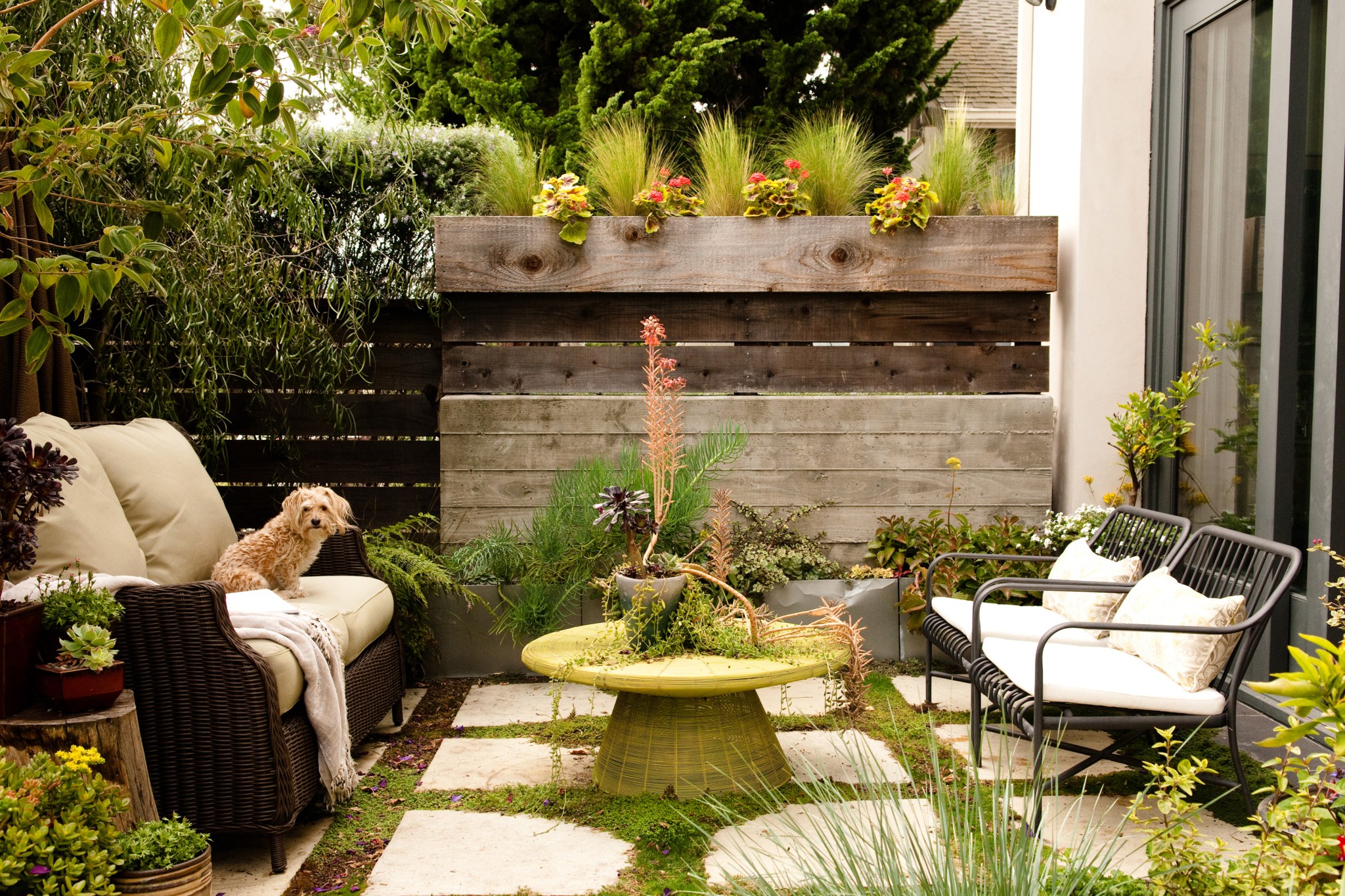

Don't think of your microscopic yard as a curse. So what if it's technically a small concrete slab that baaarely accommodates a half-sized Weber grill? Or if your flagstone patio is just big enough for you, a lounge chair, and a good book? Your tiny outdoor spot is actually an opportunity to get creative.
To live large with a small footprint, try these functional tweaks to make your minuscule outdoor space feel like a palatial retreat.
1. Divide the Space
Wait, what? That's right. Even if your square footage is relatively small, dividing your outdoor space into two areas can actually make it seem bigger.
"Creating a space within a space makes it seem larger because it gives you a separate experience," says Joy Diaz, chief marketing officer at Land Care Inc.
Diaz recommends a small wood pergola, which you can purchase at home improvement stores or even build yourself without too much effort. You can also use walls to divide the space. We're not talking about bulky concrete barriers here — try using short trellises, arbors, or vine-covered wooden fences to separate your loungers from your patio table.
"It says, 'I'm in one place, that's another place, and if there's room for two places it must be big,'" says J. Scott Williams, a landscape architect at YardApes in New Milford, Conn.
As an added bonus, walls prevent visitors from walking in a straight line from one end of the patio to another, instead creating a winding path that makes your small space feel expansive.
2. Plant a Privacy Screen
A peaceful space always feels roomier than one crowded with noise and other distractions — like the pressure to strike up an awkward conversation every time you lock eyes with the nice lady next door. Keep your evening soirées and morning coffee blissfully secluded with a few cleverly positioned plants.
There are a few ways to achieve this goal. Along the very edges of your space, plant a tall, wide bush, like the purple smoke bush, a fantastic, easy-to-care-for container plant that can grow six or seven feet every year. Just be sure to keep on top of trimmings to keep it from overgrowing your patio — you want it growing up, not out — but as long as you do so, it makes an excellent privacy screen.
"A larger plant in a small space is dramatic," says Williams.
You can also privatize your patio without sacrificing any square footage with the oldest trick in the book: Install some climbing vines on a trellis to clearly tell your neighbors, "This is my special space."
3. Add a Water Feature
A dramatic focal point can really add some intrigue to a mini yard. And a water feature, like a bubbling birdbath or wall fountain, can do just the trick.
Williams suggests choosing an element with a black bottom, which will create a darker surface that reflects sky and trees, making your outdoor space feel bigger. Just make sure your water feature doesn't overwhelm your porch — you can skip the long, vanishing edge-style pool.
"I wouldn't put a longer element in a small space, which might make it look smaller," Williams said. "Add a smaller water element into a small space, and make it seem larger."
4. Use Vertical Space
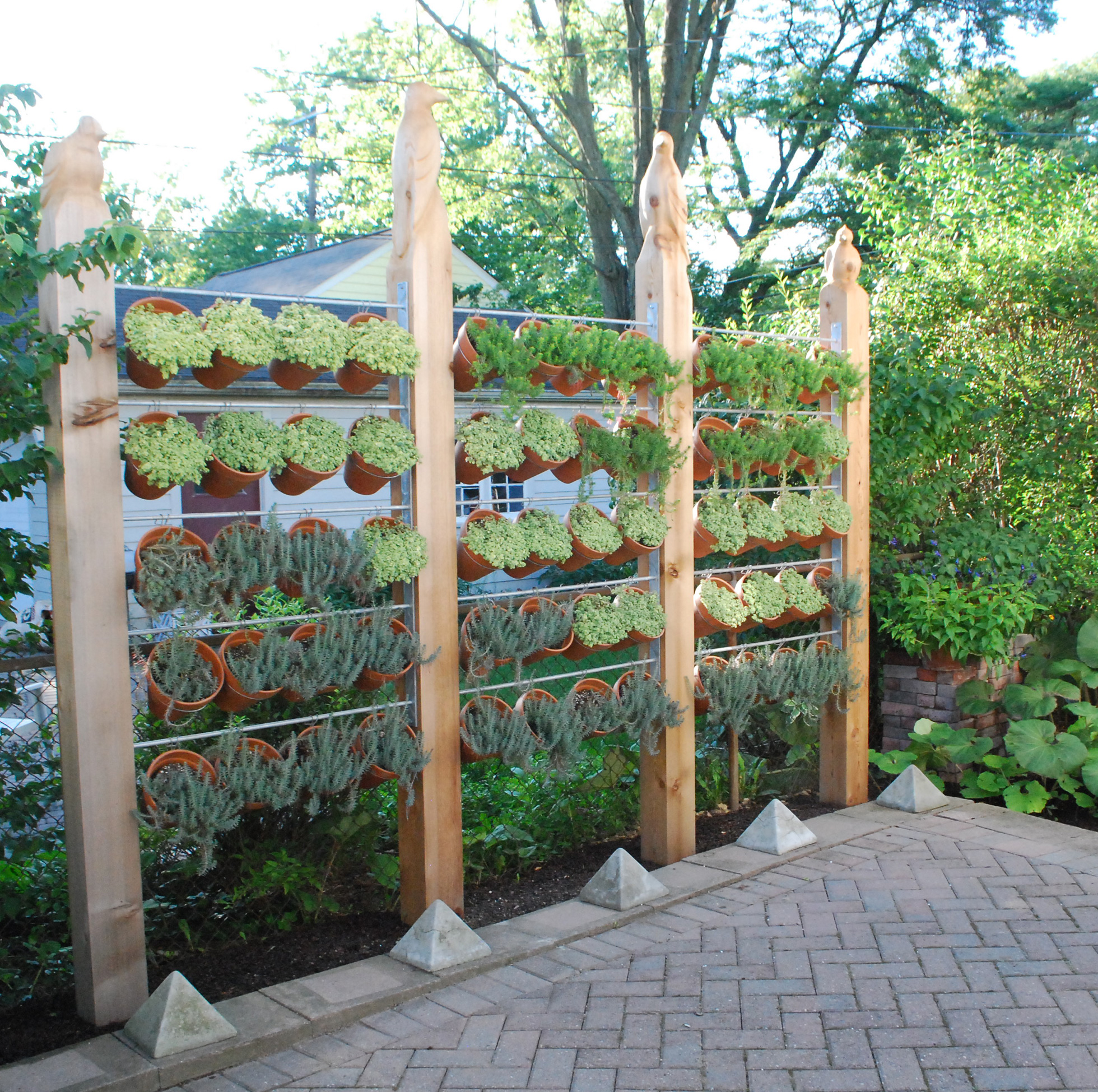

Distract from your lack of horizontal yardage by really maximizing your outdoor space's most abundant dimension: vertical space.
Use your walls, fence, or railings as extra space by adding vines or a living wall filled with flowers, herbs, and other eye-catching greenery. For a simple change, prop an attractive ladder — think barnyard chic, maybe? — against the wall and use its rungs as shelving for plants or other decor. The internet is bursting with other vertical planter and shelving ideas, too, using everything from pallets to chicken wire.
"It draws the eye up and outwards, and gives it a green and completely different look," says Diaz. "It can change the atmosphere of the area. You've walked into a different experience from your home — it's a psychological and emotional change."
5. Expand Space with a Mirror


"Mirrors really make space feel more expansive," Williams says. On a small porch, place a tall mirror on the ground behind a portico or a patch of greenway, which "makes it look like a doorway into another garden."
You don't need to go huge on the mirror to have a huge impact. Even hanging a normal-sized mirror, like one you might find over a dresser, can make a tiny space feel much larger. But whichever you choose, make sure to weatherproof your mirror first using a mirror edge sealer (you'll also want to add sealant to the frame, especially if it's made from wood) to prevent moisture damage — unless you like the weathered look, that is.
Small spaces don't have to be limiting. With a little bit of creativity — and perhaps a reflective surface or two — there's no reason you can't feel like you're living in your very own Versailles.
Related: