You care about your home. The NATIONAL ASSOCIATION OF REALTORS® cares about homeownership. To help you become the best, most responsible homeowner you aspire to be, we want to provide you with free information and tools you can use to make smart and timely decisions about your home.
From time to time, we may reach out to you to help us support legislation and/or policies that may have an impact on you, the homeowner. You can choose to join our cause. Or you can choose not to. Regardless, your privacy is safe with us.
We'll never share or sell your email address or other personal information you may provide us in the course of using the site with anyone without your explicit consent.
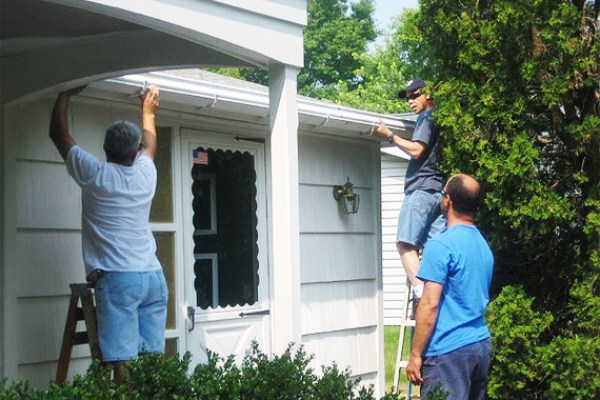
Fixing up the house of a special friend or neighbor who needs a helping hand is a Christmas gift that shows you care. It doesn’t cost much, and it’s easier than giving nine ladies dancing.
Replacing the trim around your home can make it feel much more vibrant and clean. Image: Fypon®/HouseLogic
Over time, interior trims can take quite a beating. While some trims, such as decorative crown molding, are out of the way and don’t get nicked, others are in the thick of the action. Baseboards, chair rails, and door casings get everyday bumps and bruises, and usually have the scars to prove it.
With some simple repair tips, however, you can repair dinged trim to near-original condition. You’ll be amazed at how blemish-free trims make an entire house feel clean and vibrant.
Spot cleaning
Some spots and scuffs are surface blemishes that you can erase with a little elbow grease. Try a microfiber cloth dipped in a little commercial cleaner. If you’re eco-conscious, green clean with a 50:50 mix of white vinegar and warm water.
Be sure to swipe the top edges of moldings and trims — those little places are notorious for grabbing dust.
Fixing gaps
Wintertime usually means drier indoor air, which makes moldings shrink lengthwise a tiny bit. When that happens, seams between trim pieces open up, creating gaps.
Fill these gaps with color-matched caulk. Use a good grade latex caulk that will flex when moldings expand and contract with changes in humidity. If the molding has a custom color, make sure your caulk is paintable, and touch up to match when the caulk has dried.
Nail holes
These little trouble spots show up when old filler or paint falls out of the indentation made by the nail. First, check the hole — if the nail isn’t set deep enough, the head probably prevented any putty from taking firm hold.
Reset the nail, using a narrow nail set. Hold the set firmly and strike it gently with a hammer until the nail head is 1/16- to 1/8-inch below the surface.
Refill the hole with color-matched wood filler (it’ll work for composite trim, too). Scrape the top of the repair gently with a putty knife to remove excess filler — otherwise you’ll leave a noticeable bump.
If you can’t find color-matched filler, repair the hole and gently sand the area smooth. Spot paint to match.
Gouges and cracks
You can repair larger dings using wood filler. However, you may have to build up the filler in stages to get a good repair. Take your time, and plan on repainting the entire length of trim to hide the blemish.
Replacing trim
This surefire fix-it is the more elaborate approach, but it really doesn’t take that long and new trim is relatively cheap — you can find 5-inch-wide baseboard for about $2 per lineal foot.
First, use a utility knife score along the edges of your trim where it meets wall and floor surfaces. That’ll help prevent pulling off paint when you remove the trim.
Gently pry off the trim. To get started, use a tool with a fine blade — a chisel or stiff putty knife works well, or a small pry bar with a thin blade made of tight spaces.
Never pry directly against a wall or other surface — you could easily break through, making a hole in the drywall. Instead, put a drywall knife or a piece of plywood between your prying tool and the wall, and pry against that.
Once you’ve started to move the trim away from the wall, you can graduate to a bigger plying tool with more leverage if you need — a good-sized claw hammer is great.
Take the old trim to your home improvement center so you can find an exact match.
Got an idea for helping out a neighbor or family member with home improvement and maintenance chores?
has written seven books on home improvement and hundreds of articles on home-related topics. He’s been a residential builder, the editorial director of the Black & Decker Home Improvement Library, and the executive editor of Better Homes and Gardens magazine.